



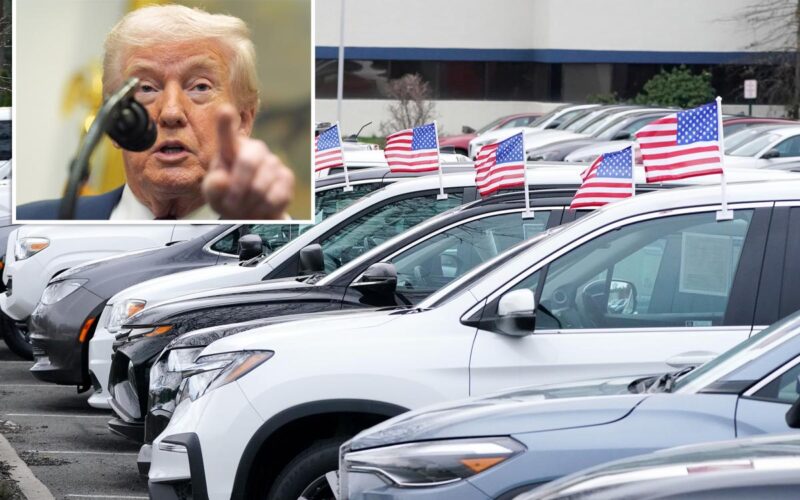
The Trump administration’s repeal of the Obama-era “endangerment finding” will lower car costs by an average of $2,400 per vehicle, the White House and Environmental Protection Agency (EPA) touted Thursday.
Here’s why.
The action announced by President Trump and EPA Administrator Lee Zeldin ends former President Barack Obama’s sweeping anti-greenhouse gas policy, which allowed the EPA to measure and constrain emissions of carbon dioxide, methane, nitrous oxide and other gases from all vehicles and engines of model years 2012 and beyond.
Regulating greenhouse gas emissions under the 2009 policy added “incalculably large” costs to carmakers and consumers, according to one expert, who suggested the savings could be even larger than what the Trump administration expects.
“The EPA has estimated benefits to the economy from rescinding the endangerment finding for vehicles to be as much as $4.7 trillion for the period 2027-2055. This is a gross underestimate,” Steve Milloy, a former Trump EPA transition adviser and senior fellow at the Energy & Environment Legal Institute, told The Post.
“Because of this move, gas prices will remain low and car prices will decline,” the biostatistician and environmental lawyer added. “Lower gas prices and lower vehicle prices will ripple through the economy for decades to come.”
Milloy noted that consumers and businesses also stand to benefit from the deregulation of emissions by being able to redirect money saved on vehicle costs.
“All these benefits are impossible to calculate. But there’s one thing for sure: The costs of regulating greenhouse gas emissions is incalculably large while providing absolutely no environmental benefit,” he said.
The EPA notes that both the “avoided costs of purchasing equipment related to [electric vehicles],” which carmakers increasingly began manufacturing in the wake of the 2009 policy, and reduced “regulatory compliance costs“ will also contribute to lower prices.
At the White House, Zeldin proclaimed that “manufacturers will no longer be burdened by measuring, compiling or reporting greenhouse gas emissions for vehicles and engines.”
Ford Motor Company, one of the “Big Three” American automotive manufacturers, celebrated the decision to scrap Obama’s emission standards.
“We appreciate the work of President Trump and Administrator Zeldin to address the imbalance between current emissions standards and customer choice,” a spokesperson told The Post.
“Ford has consistently advocated for a single, stable national standard that aligns with customer choice, the market, societal benefit, and American job growth.”
Tim Pohanka, vice president and executive manager at the Virginia-based Pohanka Automotive Group, cautioned that it might take some time for prices on new cars to come down by as much as the Trump administration predicts.
“Is there a potential opportunity for people to save? Yeah, there is. But it can’t be coupled with having to pay more at the gas pump, so it’s all relative,” Pohanka said.
“Would we see a price reduction of $2,400 right away on a car? Probably not,” he added. “I would have a hard time really saying exactly how that number would break out.”
Pohanka explained that the industry is facing an “affordability crisis” and is hopeful that Trump’s move does bring costs down.
“The cost of a car has outpaced inflation dramatically,” he pointed out.
Trump and Zeldin also announced Thursday that the start-stop feature “forced” on American car buyers under Obama’s endangerment finding would no longer be a requirement on new vehicles.
Pohanka cited that fact as another move that could lower costs.
“Every time they put new components in the car, it adds cost,” he said. “When you start to look at auto-start, auto-stop buttons, it plays an impact on the car.
“Removing the complexity from that hardware will make a difference.”
Pohanka noted that the feature may cause “harm to the engine and battery components,” which also adds to consumer costs when repairs are needed.
Lauren Fix, an automotive analyst at The Car Coach, believes Trump’s actions will indeed make cars more affordable, though she’s unsure where the administration came up with the $2,400 figure.
“On every car brand, it’s going to be slightly different,” she explained.
But overall, “this is a win, making cars more affordable,” Fix continued.
“There are some people saying this is a bad thing, but the truth is you can’t always go with what the government says because they don’t know the industry – they don’t build cars.”