



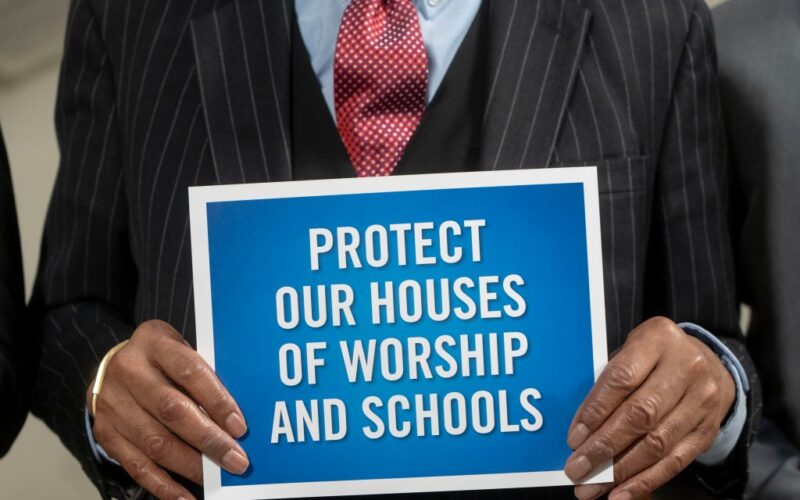
We represent four different faith traditions. We do not agree on everything. But we agree on this: New Yorkers must be able to freely enter their house of worship without fear of injury or intimidation.
Unfortunately, in recent months, this principle has been tested.
Recently, a protest took place directly in front of a historic synagogue in the heart of New York City. Congregants were forced to walk through menacing crowds to reach the entrance. That day targeted a synagogue, but tomorrow, or next month, it could be a mosque, a church, or any denomination deemed “the other.”
When the entrance to a house of worship becomes the site of confrontation, something deeper is threatened. Every New Yorker deserves to practice their faith without fear.
Currently, houses of worship do not have the same clear, distance-based protections that apply to other sensitive sites such as polling places or reproductive health clinics. Enforcement is largely reactive and conduct-based, which can leave clergy and congregants uncertain about what to expect when tensions rise.
New York can, and must, do better.
To be clear, the City Council’s safe access proposal does not ban protests, create new crimes, or criminalize peaceful expression. It requires the NYPD to develop and publicly share a clear plan for how it will respond when there are credible safety concerns or blocked access at houses of worship.
We know from our faith communities and from empirical research that an overwhelming majority of New Yorkers support this kind of policy.
That plan must spell out when perimeters are established and removed, how distances are determined, how emergency access is preserved, and how officers engage with the public. Importantly, it must be posted publicly. Transparency protects clergy, congregants, and protesters alike.
Clear rules prevent confusion. Clear expectations prevent escalation. And clarity strengthens constitutional rights rather than weakening them.
Some frame this as a choice between free speech and religious freedom. New York has long protected both. We safeguard protest even as we protect access to schools, hospitals, and polling places. Houses of worship deserve the same thoughtful balance.
Too often where outrage follows an incident, statements are issued before attention fades. Too often, nothing changes, leaving the door open for the next confrontation to unfold.
The time is different. Council Speaker Julie Menin’s legislative package is a response to both the incident, and to the broader trends of rising hate across the city. This immediate action demonstrates the leadership that got Menin elected as speaker — it replaces momentary outrage with a practical framework for safety.
A durable framework is better than temporary condemnation. It gives communities confidence that their safety is not dependent on the news cycle.
This approach recognizes reality: not every protest is the same, and not every location presents the same risks.
New York is its best when diverse communities can gather in peace, even when we disagree outside those walls. Protecting that space does not limit speech, it preserves the conditions that allow pluralism to thrive.
We may worship in different ways. We may pray in different languages. We may champion different causes while exercising our right to free speech. But we stand together in this conviction: safe access to houses of worship is not partisan, not sectarian, and not negotiable.
It is fundamental to our identity as New Yorkers. The City Council understands that.
Potasnik is the executive vice president of the New York Board of Rabbis. Bernard is founder, CEO and pastor of the Christian Cultural Center. Heyd is the Episcopal bishop of New York. Ali is imam of the Iqra Masjid Community & Tradition mosque.