




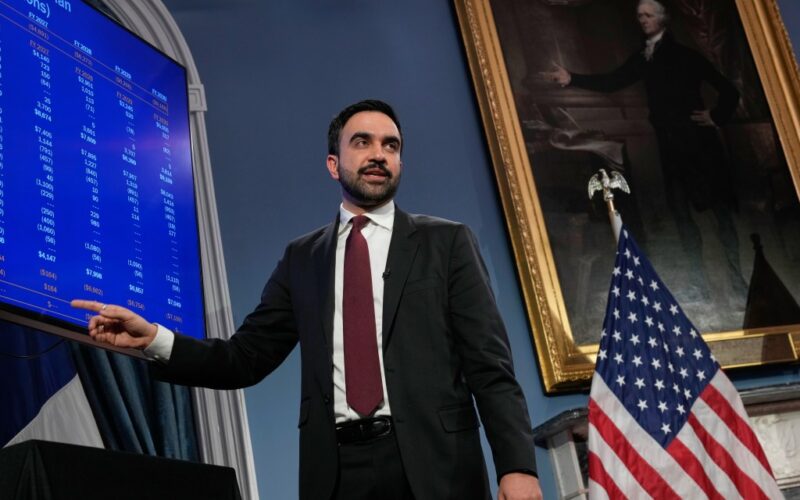
When Mayor Mamdani released his preliminary budget last week, the public got to see what governing with prose looks like. It looks very different from campaigning in poetry.
Faced with the reality of a massive budget deficit that he chose to ignore during his campaign, Mamdani took hostage New York City homeowners and other property owners by threatening to increase property taxes by 9.5% unless Albany passes the tax increases he has been calling for as part of his affordability agenda, which he would instead use to cover the city’s $5.4 billion budget deficit.
The next six weeks between now and the end of New York State’s fiscal year (and however longer it takes to actually get an enacted Budget) will be fascinating to watch.
Will the Assembly or the state Senate include the mayor’s tax increases in their “One House” budgets? How will Gov. Hochul respond to being jammed by the mayor’s preliminary budget threat? How will organizations like the New York City Partnership — which bent over backwards since the primary to normalize the new mayor — react?
For all the drama, I expect the endgame will be that the state bails out New York City through a combination of a corporate income tax increase and the state absorbing more costs that currently fall on the city. An obvious target would be to have the state pick up the costs of its unfunded mandate to require a reduction in class size in New York City.
The governor cannot afford to roll over on the mayor’s proposal to increase New York City’s income tax on high earners. Hochul spent the first several years of her governorship battling the public and insider perception that she was weak. There is no stronger epithet in Albany than the charge of being weak. But the governor has given herself wiggle room when it comes to corporate taxes and the state budget is in such strong shape that it can quietly shift more funding to New York City.
Mamdani’s effort to blame this budget “crisis” on former Mayor Eric Adams is undermined by the fact that Mamdani not only doesn’t disagree with any material spending programs of his predecessor, but favors expansion of programs like CityFHEPS that Adams tried to block. The real cause of New York City’s budget hole is that the city launched programs from universal 3-K to the expansion of CityFHEPS that its revenue base couldn’t support.
Rather than re-examine whether the city can afford these programs, the mayor has launched a second front to obtain more funding from Albany, which is that New York City is not getting its fair share of state spending relative to the amount of state tax revenue it contributes. Expect to hear “End the Drain” a lot in the coming months and years.
The mayor is gaslighting the public to make his case by using misleading statistics. The statistics Mamdani uses to claim that “New York City contributes 54.5% of state revenue but only receives 40.5% back” are derived from a report titled “The Fiscal Flow between New York City and Albany: A Data-Driven Assessment of New York City Revenue Contributions in the New York State Budget” from the CUNY Institute for State & Local Governance and the Center for New York City Affairs at The New School
In terms of the state tax revenue “contributed” by New York City, the 54.5% statistic includes personal income taxes paid by commuters who work in New York City but reside elsewhere. The percentage of state tax revenue based on income taxes paid by individuals who reside in New York City is 46.7%.
There are other methodological problems with the report’s estimate of the amount of state spending New York City receives back. The “40.5% back” statistic includes in the denominator total state spending funds spent on “state operations.”
These expenditures, which range from employees in state agencies to corrections officers in upstate prisons, reflect activities that benefit all residents of the state, but in the report are coded almost entirely to “Rest of State.” Excluding state operations from the denominator of total state spending increases the percentage of state spending directed to New York City is 48.2%.
A more detailed review of the report would likely indicate other areas in which state funding that benefits New York City is undercounted. In the end, I think it is probably fair to say that New York City contributes nearly half of state tax revenues and gets back in return roughly half of state spending that is locality specific.
Even if Mamdani were right about the “balance of payments” between New York City and New York State, it would not be dispositive. the logical extension of his principle, which would lead to increasing the amount of state budget funds directed to suburban areas that get back a much smaller percentage of the tax revenue they sent to the state than is the case in New York City.
Ironically, Mamdani’s suggestion that the measure of equity in governmental funding should be whether a jurisdiction get as much back in spending as it provides tax revenue is practically the inverse of progressivism. Democrats and other progressives usually maintain that one of the purposes of government is the redistribution of funds from those who have more and need less from the government to those who have less and therefore need more from government.
Mamdani entered into a Faustian bargain with New York City voters by promising in his campaign that he could offer a sweeping range of transformative programs financed by additional tax revenue. It’s now clear that he will need that additional tax revenue not for sweeping programs but just to keep the lights on. We will learn in the next six weeks or so what price needs to be paid for that bargain.
Francis, a former state budget director, is the chairman of the Step Two Policy Project.