




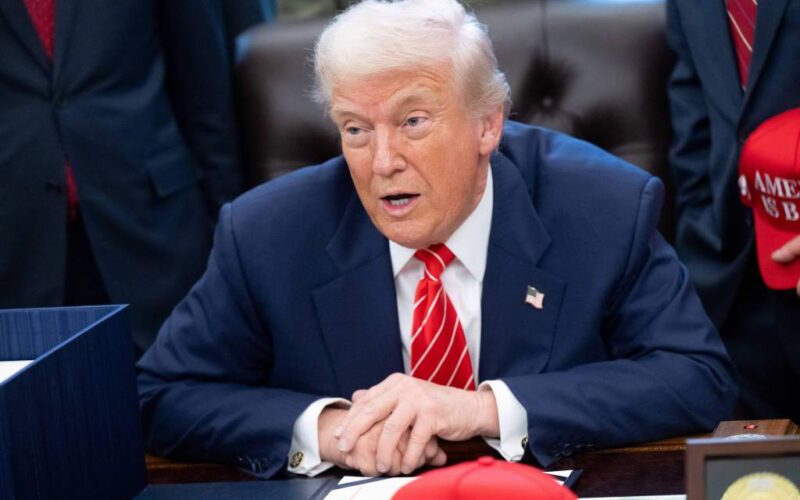
Donald Trump has rewritten the rules of the presidency in ways that could change America forever, and not for the better.
His naked self-dealing, weaponizing the Justice Department against his political foes, turning on our allies, the casino-fication of the White House — none of it bodes well for the future of our democracy, setting precedents that other presidents on both sides of the aisle could very well continue.
But one of the most obvious things Trump has changed in politics is its concern with ideology and principle. The longheld philosophy that used to bind the Republican Party together is gone, because he simply didn’t have a use for it.
For conservatives, that’s been especially disorienting and troubling. It began with Trump’s disregard for the debt and deficit, and carried through to this term’s embrace of tariffs, or protectionism. His personal disinterest in what the Christian right used to call “family values” dismantled the evangelical base of the party. And his courting of white nationalists and antisemites changed the face of the party.
None of that has been enough, however, to move conservative lawmakers to significantly break with Trump or even call him out. They happily co-signed his tariffs, watched as he exploded the debt and the deficit, turned the other way at his criminality and immorality, and defended police-attacking insurrectionists at the Capitol. He even managed to tick off the Second Amendment crowd with his crackdown on guns at protests and in Washington.
None of this is conservative. But so long as they kept winning, cowardly Republicans not named Liz Cheney or Adam Kinzinger didn’t seem to care.
But now, with a new idea hatched, will Republicans finally remember their conservative roots?
On Monday, Trump called on Republicans to “nationalize the voting.” It was a startling suggestion for a party that’s always concerned itself with state’s rights and federalism.
“The Republicans should say, we want to take over, we should take over the voting, the voting in at least many, 15 places. The Republicans ought to nationalize the voting,” he said.
The call is in service of his election lie, of course, an answer to the non-existent scourge of voter fraud that rigged just the 2020 election and somehow not the 2016 or 2024 elections.
Except Trump is the one attempting the rigging. He’s tried to end mail ballots and voting machines, sued two dozen blue states for their voter rolls, embarked on a rare mid-decade redistricting campaign, dismantled the FBI’s Foreign Influence Task Force, and pardoned dozens of people who signed false election certifications for him in 2020.
It’s tempting to dismiss the idea as merely a self-soothing ramble, the nonsensical blurting of an old man still fixated on an imaginary injustice. But it should offend and worry everyone, not least of all Republicans.
Elections are held locally for good reason — it’s harder to rig them that way. The Constitution says states shall determine the times, places and manner of elections, for the explicit purpose of decentralizing and protecting their integrity. It’s the backbone of federalism.
But for House Speaker Mike Johnson it’s nothing to get worked up about. “What you’re hearing from the president is his frustration about the lack of some blue states, frankly, of enforcing these things and making sure that they are free and fair elections.”
But Democrats are rightly concerned, and preparing for potential “federal government intrusion” in the midterms. “This is now a legitimate planning category,” said Minnesota Secretary of State Steve Simon. “It’s extraordinarily sad, but it would be irresponsible for us to disregard the possibility.”
Extraordinarily sad, indeed. But will it revive the dormant conservatism in the Republican Party? Will lawmakers remember their principles and patriotism? Or will they continue to sleep through Trump’s total remaking of America’s political system?
Maybe this will be the thing that finally wakes them up.