




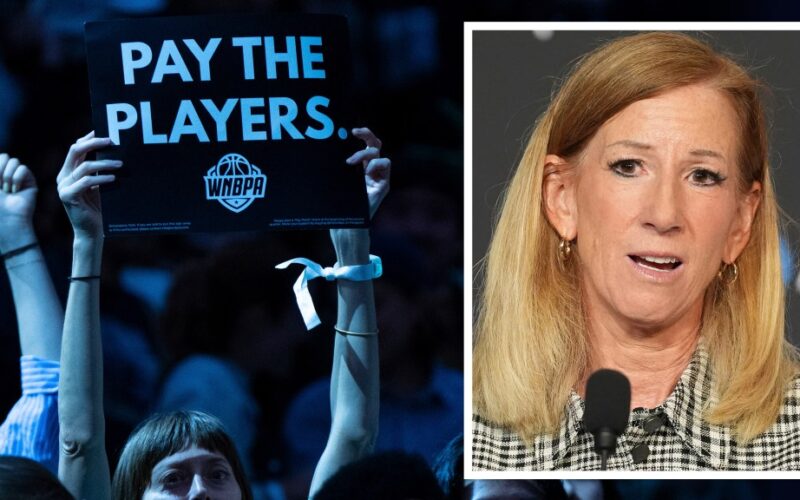
The players are trying to fight a good fight, seeking a massive improvement to their unimaginably one-sided collective bargaining agreement. Public sentiment is largely on their side.
But with the WNBA holding firm and time running out, it sounds like the players are folding — and that could mean another disappointing deal that’s projected for six more years.
The WNBA presented a new CBA proposal to the WNBPA on Sunday, a source with knowledge of the information confirmed to the Daily News on Monday.
The biggest takeaways from the proposal are changes that allow accelerated maximum contract eligibility for star players on rookie contracts and an increase in the Year 1 salary cap to $5.75 million. Based on league projections, the cap will grow to roughly $8.5 million by Year 6, according to the source.
The league’s cap for the 2025 season was set at $1.5 million.
The Associated Press was first on the details of the league’s latest proposal.
“I want to play, and players want to play,” WNBPA first vice president Kelsey Plum said at Unrivaled shootaround hours before leading her Phantom squad to a victory in Monday night’s semifinal game at Barclays Center. “And so obviously we’re going to continue to negotiate and do everything we possibly can to get this done in a timely fashion. But obviously a strike would be the worst thing for both sides, because we are in a revenue [sharing system], so no revenue, no revenue to share.”
The entire deal, however, seems designed to squeeze the WNBA’s middle class in order to facilitate high-profile raises to high-profile players. With an overwhelming majority of players slated to hit the market when an agreement is reached, the ramifications of a deal like this will be immediate.
The average salary — which was set at $120,000 for the 2025 season — would be more than $535,000 in the first year and grow to more than $775,000 in 2031. That increase is just a measly $5,000 pay bump to what the league proposed back in December. More importantly, that is merely the average salary, which will be heavily influenced by the newly lucrative maximum contracts. The median salary, which more accurately reflects the average player’s expected earnings, is currently unknown.
The crumbs Cathy Engelbert and the league are spitting out at the players become a bigger issue for teams that have players qualified for accelerated max salaries, like the Indiana Fever.
Under the latest proposed CBA, All-WNBA First and Second Team players who are still on rookie contracts would become eligible to sign a maximum contract in their fourth year and wouldn’t be eligible for core designation following that extension. The WNBA’s core designation functions similarly to the NFL’s franchise tag.
And a player on a rookie scale contract that wins a Most Valuable Player Award could similarly be eligible for a supermax deal.
For instance, the Indiana Fever currently have two players on track to sign max deals after landing on All-WNBA teams early in their pro careers: Aliyah Boston (eligible to sign in 2026) and Caitlin Clark (eligible to sign in 2027).
The prospect of having two maximum salaries — projected at $1.3 million in Year 1 and reaching nearly $2 million in 2031 if the proposed deal goes through — under the aforementioned hard salary cap puts the Fever front office in a bind.
Essentially they’ll be penalized for doing what front offices strive to achieve — drafting the right players and cultivating an environment that enhances their development.
Just imagine a potential unfortunate trade that sends out Clark or Boston. Such a moment in a hoops town would send shockwaves across the nation — like the silly, finance-driven trade that sent ex-Red Sox star Mookie Betts to the Dodgers. Shipping Clark out would evoke the same feeling Dallas fans felt when the Mavericks trade beloved star Luka Doncic to Los Angeles.
All this is possible under this new proposed CBA.
It’s a disaster waiting to happen.
And even if the Fever decide to pay both players, it is their teammates who will pay the price, with the crumbs left over in a hard cap environment. Fever guard Kelsey Mitchell deserves a hefty payday after wrapping up a career year, finishing fifth in MVP voting and landing on the All-WNBA First Team, but will likely find it difficult to reach an equitable agreement in Indiana with Boston and Clark’s deals on the horizon.
* * *
Months ago, the players gave the impression that they would have rejected an offer like this out of hand. But their resolve appears to be slipping, and the WNBA is taking advantage.
“I think now, we’re in such a pivotal moment that we don’t want to mess it up,” Liberty star and Unrivaled co-founder Breanna Stewart said last July when speaking of the importance of getting a new CBA done.
“And you could look at the last CBA and be like, ‘well, we got some good things,’ but we actually agreed to a lot of things that we don’t like, and making sure that that doesn’t happen again.”

On Monday, the tune changed. It looks like there are some bad things likely to get passed. It’s happening again.
Suddenly, it looks like the WNBA will win the battle.
The players are now seeking an average of 26% of gross revenue, down from their previous request of 27.5% while the league still refuses to engage with them on gross revenue — which would imply true partnership, as other leagues have — instead insisting on paying out the teams before getting around to the players. The league’s latest offer is 70% of net revenue, per ESPN.
Even Stewart agreed with Plum, seemingly changing tunes after several months of declarations that the players would eventually get what they deserved.
“I think that while we still are fighting for a lot of different things, we have to realize that the rev share is a win, especially just even coming from the 2020 CBA and the ones before that,” she said. “Now, as the league makes money, we make money. And so when [Plum] talks about ‘I don’t think a strike is good for anyone,’ because as the league loses money, or if we have a delay, we also lose money.”
Despite the players’ tone suggesting otherwise, a strike is still possible. In December, the executive committee voted in favor to authorize a strike “when necessary.”
WNBPA vice president Alysha Clark reaffirmed that on Monday night with a social media post stating “A strike is very much still on the table.”
What works in the WNBA’s favor, though, is time — or the lack thereof.
The league reportedly sent the union a firm March 10 date to get a deal in place in order to start the season on time (May 8).
That’s just one week left for the players to fight. One more week for Cathy and co. to keep playing hardball.