



Bernie Williams has rocked with Twisted Sister and shared a stage with the New York Philharmonic.
He’s played at Abbey Road, Café Carlyle and Yankee Stadium, where he’s delivered renditions of the national anthem on his electric guitar.
He even performed with a tribe of Nubians on the banks of the Nile River in Egypt.
But nothing quite compares to what’s next for the former Yankees center fielder.
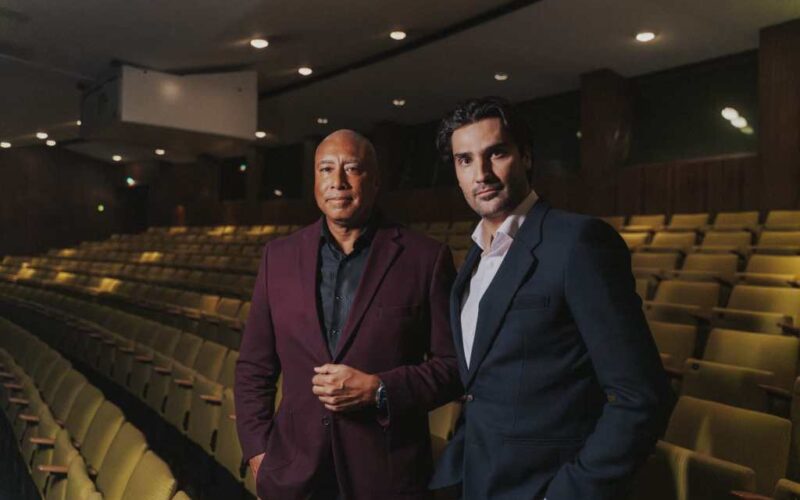
Williams is set to co-headline a Jan. 13 concert at Carnegie Hall with renowned tenor Jonathan Tetelman in a performance fusing sports and classical music.
“It’s gotta be, probably, the most important venue that I’ve ever played in my whole career, as far as a musician,” Williams, 57, told the Daily News during a recent interview in Manhattan.
The concert marks Williams’ Carnegie Hall debut and is billed as a blend of opera, jazz, Flamenco and more mainstream material such as the Beatles and “Maria” from “West Side Story.”
Williams, who is a classically trained guitarist, and Tetelman, a powerhouse vocalist, are set to be joined by a band that includes a string section from the Metropolitan Opera.
“It has proven to be challenging because of the scope and how ambitious we want this project to be,” Williams said.
“I mean, you’re talking about [Giacomo] Puccini and really hardcore opera and paring it down with the Beatles, and maybe things that [Andrea] Bocelli could sing. … It’s very eclectic, so it makes it very ambitious. Our idea is to try to do good by the music, not just to have a jack of all trades and master of none.”
The concert further bolsters the musical résumé of Williams, who spent his full 16-year MLB career from 1991-2006 with the Yankees and played a central role in four World Series championships.
Even during his baseball career, Williams maintained his love of music, which started when his father taught him a few guitar chords when he was 7 or 8 years old and only strengthened as he attended a performing arts high school in his native San Juan, Puerto Rico.
“For all practical purposes, I thought I was going to be a musician, but I was playing baseball on the side. I was playing little league on the side, and then when I turned 15, 16 years old, I started being looked at by professional teams,” Williams said.
“I ended up signing with the Yankees to play this great career in New York … but through my whole journey in baseball, I never left the guitar. I never said, ‘Well, this is something I did when I was a young kid. I’m just gonna forget about it and just kind of move into this.’ I always kept it with me.”
Williams hit .297 with 287 home runs, 1,257 RBI and an .858 OPS during his MLB career, and he earned five All-Star selections and four Gold Glove awards. The Yankees retired his No. 51 in 2015.
But being in New York also proved beneficial with Williams’ other pastime, as it introduced him to new music genres.
Williams released his debut studio album, “The Journey Within,” in 2003 while he was still a member of the Yankees. He received a Latin Grammy nomination for his second album, “Moving Forward,” which came out in 2009.
“It wasn’t until I came to New York when I actually became more cognizant of blues and rock and jazz,” Williams said.
“It was all about the traditional music of Puerto Rico back then, and classical music, where I kind of grew up listening to it because of the high school experience. But it wasn’t until I came here when I started really playing electric guitar and playing with a stomp box pedal and listening to what overdrive sounded like.”
Seven years after his final season with the Yankees, Williams enrolled in the Manhattan School of Music as a 45-year-old freshman.
That four-year program allowed Williams to pursue a college degree, much to the delight of his mother, but also to earn credibility in music and find his purpose as a performer.
“Training to be a musician, it could be about competition, but not really. I wasn’t really [trying] to be the best guitar player and being in the Hall of Fame of guitar players. That was not what was driving me. I had all of that in the baseball world,” Williams said.
“[I realized] I could be the best [guitar] player that I could be and enjoy the journey in more of a spiritual kind of way. … Expressing my creativity and being an artist in this journey, and the more I put into it, the more I can get out of it. And to me, it was all about being able to perform with everybody, regardless of the genre, and feel like I belong.”

That sentiment is at the crux of Williams’ Carnegie Hall concert.
The show is the marriage of two powerhouses in their respective fields, with the unity achieved through sports serving as a theme. José Reyes and Stephon Marbury are among the special guests who are set to contribute to the performance.
“The more that I start talking about this, I start really realizing the scope and the magnitude and the ambitiousness of this project,” Williams said.
“It could be overwhelming at times, but I think we’re going to have a good mix of music that is going to make it available for people that maybe are just so hardcore classical music listeners … and, conversely, people that are in the pop world, jazz world.”
It’s a performance five decades in the making for Williams, going all the way back to his father’s impromptu guitar lessons in Puerto Rico.
“When you play baseball, you kind of have your worth given to you by your stats. How good you were is kind of predicated upon your numbers,” Williams said.
“As a musician, on the other hand, I think I kind of value how successful I am by the places I play at and the people I play with. So with that said, this opportunity to play at Carnegie Hall with Jon Tetelman … has to be right up there with everything that I could ever ask for.”