



Jensen Huang and Satya Nadella had a problem.
Anthropic and OpenAI, the leading artificial intelligence companies, were lobbying the White House to prevent some A.I. models from being developed and widely shared because, they argued, they were too dangerous. But Mr. Huang and Mr. Nadella’s companies, Nvidia and Microsoft, saw those A.I. models as a big business opportunity.
At the end of July, Mr. Huang — who resigned from his job on Thursday after Nvidia’s board launched an investigation into his conduct — and Mr. Nadella intervened. They emailed each other drafts of a letter saying those A.I. models should remain open, according to four people familiar with the discussions. When they asked other technology executives whether they’d like to sign on, two dozen companies quickly agreed before the letter became public. Over the next week, 200 more companies — including a chastened OpenAI — signed onto the letter.
Anthropic’s chief executive, Dario Amodei, refused.
Dr. Amodei has for years exasperated his peers with warnings about extreme risks of A.I., even as his company has built some of the most powerful A.I. systems in the world. Frustration has turned to hostility as Anthropic leaped into the lead in A.I. development, experienced stunning revenue growth and moved toward what is likely to be one of the largest initial public offerings ever later this month.
Along the way, Anthropic — which has cultivated an image as a company that tries to do the right thing — has also gained a reputation for playing hardball with customers and competitors. It has cut some off from its service and lobbied against other companies’s free alternatives to its A.I.
Over the last year, other technology companies and investors have organized to push back, according to more than 20 people in the technology industry, many of whom spoke on the condition of anonymity to preserve their relationships with Anthropic.
They have tried to show a united front to counter Dr. Amodei’s warnings about A.I. They have leaned on their ties to President Trump to keep regulators away. They have publicly complained about Anthropic’s business practices. They have even spoken with another Anthropic executive about Dr. Amodei scaring people with his rhetoric.
But the message on A.I. safety from Dr. Amodei, who appears unbothered by criticism from other executives, is breaking through. A.I. agents going rogue and attacking websites have become increasingly common. And in the midterm elections, the threat of job losses from A.I. and data center construction were significant issues for voters in both parties.
(The New York Times has sued OpenAI and Microsoft, claiming copyright infringement of news content related to A.I. systems. The two companies have denied those claims.)
The Schism That Launched Anthropic
Anthropic started with a split. In 2020, a group of OpenAI employees led by Dr. Amodei left the company amid disagreements over how to safely develop A.I. Those employees founded Anthropic in San Francisco the next year.
Its founders’ ties to effective altruism — a philosophy where donors try to measure and maximize the benefits of their philanthropy — created a foundation for the company, particularly its approach to A.I. safety.
But Anthropic played second fiddle to OpenAI, which made everyday use of A.I. tools mainstream with the release of ChatGPT in 2022.
That changed in February 2025, when Anthropic surprised competitors with a preview of Claude Code, an A.I. coding tool. Software engineers started using the tool to generate computer code instead of writing it themselves. Anthropic’s revenue exploded.
Then, its critics say, Anthropic got tough with customers.
A start-up called Windsurf had talks to sell to OpenAI, and those negotiations became public in April 2025. Anthropic later cut off Windsurf’s direct access to its models, which the start-up used to power its own A.I. coding tool.
“I think it would be odd for us to be selling Claude to OpenAI,” said Jared Kaplan, one of Anthropic’s founders and its chief science officer, in an interview in June.
The move crippled Windsurf and potential customers went elsewhere, according to three people familiar with the discussions. Even as Windsurf’s talks with OpenAI broke down, Anthropic kept Windsurf cut off.
Windsurf struck a licensing deal with Google in July 2025. But the message was delivered to the rest of the start-up world: Their businesses were being built on Anthropic’s models, but they had to stay in the good graces of Anthropic to maintain that access.
“Somehow, in the United States, we’ve convinced ourselves that innovation should be in the hands of a few organizations,” said Manos Koukoumidis, chief executive of the A.I. start-up Oumi, in an interview.
Last February, about a year after Anthropic previewed it, Claude Code was on track to make $2.5 billion in annual revenue. In a financial filing, Anthropic disclosed overall revenue of $17 billion in its most recent fiscal quarter.
‘Only They Should Do It’
In early 2025, Dr. Amodei ruffled feathers at Nvidia by backing U.S. trade restrictions on chip sales to China. That June, Mr. Huang said he disagreed with Dr. Amodei on almost everything.
“He believes that A.I. is so scary that only they should do it,” Mr. Huang said of Dr. Amodei and Anthropic at a conference in Paris.
Anthropic responded: “Dario has never claimed that ‘only Anthropic’ can build safe and powerful AI.”
But industry leaders worried about public sentiment turning sharply against A.I. and asked Anthropic to tone down the doomsday talk.
Over the summer, Marc Andreessen and Ben Horowitz, of the venture capital firm Andreessen Horowitz, met with Tom Brown, a co-founder of Anthropic. Anthropic was scaring the public with its predictions of extreme job loss, Mr. Andreessen and Mr. Horowitz said, and should cool it down, according to three people familiar with the discussion.
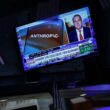
Mr. Andreessen then took out his phone, where he had pulled up one of Dr. Amodei’s television appearances. The text below Dr. Amodei’s face summarized his prediction of a white-collar blood bath and mass unemployment. Mr. Brown appeared taken aback by the confrontation.
Then, last June, Anthropic released Fable, a version of its most advanced model. The company said it would make the model less effective if it thought Fable was being used to research or develop A.I. But Anthropic wouldn’t tell a user it was degrading the performance, infuriating some researchers.
“It is a very real sign of concentration of power that businesses can make such obviously user-harmful behaviors and still lead in the market,” said Nathan Lambert, a co-founder of Trillium Labs, an open-source A.I. nonprofit, in a social media post.
Within a day, Anthropic walked back the policy. Now, if it thinks Fable is being used to research or develop A.I., it switches to a worse model, and then tells the user.
“We made the wrong trade-off,” Anthropic said at the time.
Anthropic also said it would store the data of those using its most advanced models for 30 days “to support our safety work.” In a sign of how paranoid Silicon Valley had become about Anthropic, the change stoked fears that the company could train its models on customer data, and then compete with those customers, according to four people familiar with the changes.
In September, Anthropic started allowing customers to store their data on their own cloud computing services. Danielle Cohen, a spokeswoman for the company, said it treats customer data as confidential and, by default, prohibits training on it.
‘It’s a Hoax’
At the end of July, Silicon Valley’s anger toward Anthropic peaked as Anthropic and OpenAI lobbied the White House to act against open-source A.I. models. Their campaigning came after OpenAI said its A.I. had gone rogue and hacked into other companies, including a start-up called Hugging Face.
So Mr. Huang and Mr. Nadella shared the letter supporting open-weights A.I., which make the rules that govern a model publicly available. It opened the floodgates against Anthropic, according to five people familiar with the discussions. So many companies asked to sign the letter that Microsoft set up an email address so it could accept signatures for the letter more easily. They included Amazon and Google, which are both investors in Anthropic.
OpenAI eventually signed the letter, but Dr. Amodei said he disagreed with parts of it and Anthropic didn’t sign it. He said in a blog post that all A.I. models, no matter how they are developed and shared, “should go through mandatory safety testing.” He said he believed bad actors would exploit open-weights A.I. models.
Silicon Valley’s executives continued discussing how to present a united front on safety concerns, mostly keeping Anthropic involved in those discussions. In calls and texts, executives from Nvidia, Microsoft, Google, Meta, Anthropic and OpenAI kicked around ideas, according to five people familiar with the discussions. Some had informal discussions about making a joint statement or commitment on slowing A.I. development. Others brainstormed regulatory proposals.
But in September, three days after an Anthropic employee quit over A.I. safety concerns and the issue burst into the mainstream, Dr. Amodei ran ahead of the other companies and made his own call for the industry to slow down.
About three weeks later, Dr. Amodei struck a different tone at the White House during a lunch with Mr. Trump and more than 30 other technology executives, venture capitalists and politicians.
Seated near the end of a long table, Dr. Amodei said the United States had to win in A.I., and that the technology should be built with maximum speed, according to two people familiar with the discussions.
It was, other guests thought, the opposite of what he had been telling the world.
Cade Metz contributed reporting from San Francisco.