




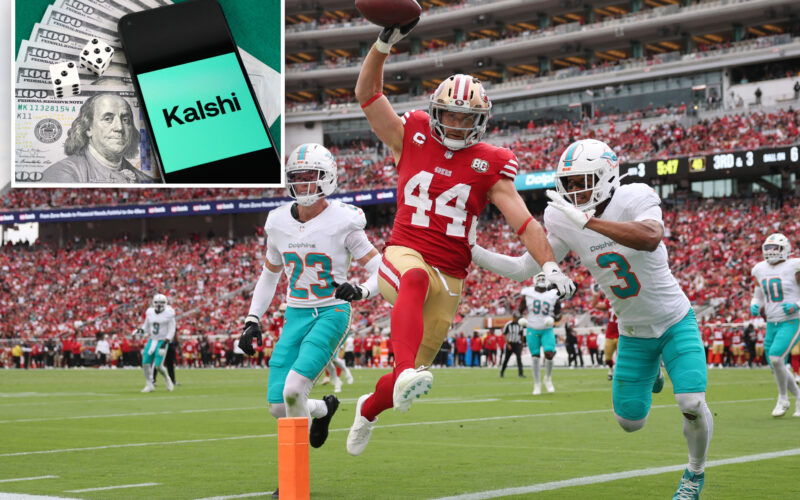
The National Football League is urging the Supreme Court to recognize prediction markets as gambling apps, joining a New Jersey challenge to have Kalshi face stricter regulations from the states.
In an amicus brief supporting New Jersey and nearly 40 other states, the NFL argued that prediction platforms offering sports bets are effectively operating as gambling platforms and should be regulated as such, CNBC reported.
On the first Sunday of the season, football accounted for $1.8 billion in prediction markets trading – more than half the total volume, the football league claimed.
The NFL’s amicus brief marks the latest twist in the heated battle to impose tighter restrictions on popular prediction platforms Kalshi and Polymarket — such as an age minimum of 21 and state taxes, like all other gambling platforms and casinos.
The apps are currently regulated as securities trading by the Commodity Futures Trading Commission, an approach critics have described as a loophole for the companies to evade gambling taxes and penalties, as well as to allow teens as young as 18 to place sports bets.
In its filing, the NFL said it is not opposed to prediction markets – but that they would be better regulated by the states, especially since the platforms are exposed to insider trading concerns.
The league said it is concerned about price manipulation, since a kicker could intentionally miss a field goal or a wide receiver could purposely fumble a pass to affect the outcomes of specific prediction markets. It added that bets about injuries and officiating are also vulnerable to insider trading.
The NFL said it wants a minimum age of 21 for sports bettors, the same as standard sportsbooks rules.
A spokesperson for Kalshi pushed back on the NFL’s claims, arguing they have consistently tried to engage with the league but have never heard back.
“Kalshi’s top priority is the integrity of its markets. That priority is reflected in the fact that every other major sports league and integrity partner in the United States is partnering with Kalshi – including the MLB, NHL, and others,” the spokesperson told The Post in a statement.
“Contrary to the NFL’s statements, the CFTC is actively policing sports-related markets, which are now listed on nearly every US commodities exchange. The CFTC’s ongoing rulemaking addresses many of the NFL’s supposed concerns. And those rules sit atop the same comprehensive system of federal enforcement that protects trillions of dollars of transactions in US markets.”
Major sports leagues are currently split on whether to buddy up with prediction markets.
The MLB, Major League Soccer and UFC have deals with Polymarket, while the NHL has partnerships with both that platform and Kalshi.
The NBA, PGA and NFL, however, have not signed on with either prediction market, and the latter even has an advertising ban on signing with the platforms.
NFL Commissioner Roger Goodell has argued the league is most concerned with protecting the integrity of the game, telling CNBC Sport in September, “We don’t feel like we have to be the first in this. We feel like we’re going to be right, and the best thing to do is be patient.”
Federal appeals courts around the country have handed down conflicting decisions over whether the prediction markets should be regulated by the states or feds.
New Jersey’s challenge – which is backed by bipartisan state attorneys general from 39 states, dozens of Native tribes and the casino industry – is seeking to overturn an appellate court ruling that found federal regulators effectively supercede the states.
In its own amicus brief, New Jersey argued that the issue “has resulted in a national turf war, splitting the nation’s courts and pitting the States against the federal government.”
New York Attorney General Letitia James has filed separate lawsuits against Polymarket and Kalshi, accusing them of running illegal gambling operations.
Kalshi and Polymarket have seen an explosive rise in popularity since launching in the US in July 2021 and December 2025, respectively.
The popular apps allow users to place bets on everything from sports and pop culture to political events – but the unique trading platforms have also faced blowback for their vulnerabilities to insider trading. Government employees and business insiders have reportedly raked in thousands from their bets on futures contracts.
In August, Kalshi slapped scandal-ridden former Rep. George Santos with its first-ever lifetime ban for allegedly making more than $17,000 by betting on his own attendance at the State of the Union.
This spring, federal prosecutors charged an Army officer for making $400,000 by trading on Polymarket using classified information involving the military operation to capture Venezuelan dictator Nicolás Maduro.
Both platforms have announced policies to prevent insider trading.
The NFL did not immediately respond to The Post’s request for comment.