



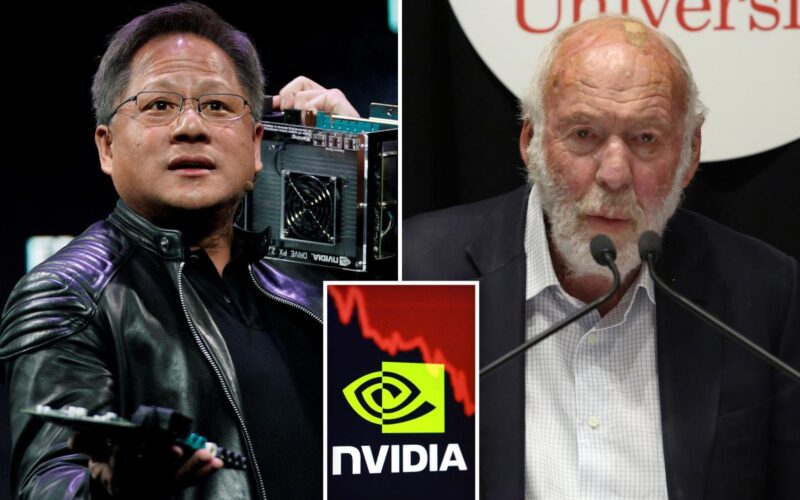
Renaissance Technologies dumped nearly all of its massive Nvidia stake before the AI darling drove off a cliff, enabling the New York hedge fund to sidestep a half-billion-dollar bloodbath — even as other big firms and the Empire State teachers’ pension fund appeared exposed to the mess, according to securities filings.
The secretive Long Island quant shop also known as RenTech — founded by the late math genius Jim Simons — held 7,091,256 Nvidia shares worth $1.42 billion as of June 30, according to filings with the Securities and Exchange Commission.
By Sept. 30, it had just 23,170 left, worth a mere $5.3 million based on Monday’s close. Had it kept the full position, the stake would have shed $512 million since Sept. 30.
There is no indication that RenTech knew of Nvidia co-founder Jensen Huang’s troubles.
The firm had sold nearly all of its shares by Sept. 30, more than five weeks before Nvidia’s board opened a probe into reports about the CEO’s personal conduct, and it trades largely on computer models.
RenTech did not respond to The Post’s request for comment.
The meltdown hits ordinary investors saving for retirement just as hard. Nvidia made up 6.1% of the SPDR S&P 500 ETF Trust as of Nov. 11, according to research firm Trefis.
Nvidia closed Monday at $156.14, down 31.6% from $228.38 on Sept. 30. Huang resigned as CEO, president and director on Nov. 11, effective immediately, a company filing shows. The shares fell as much as 14% the next day.
Some of Wall Street’s highest-flying stock pickers added shares — and are now sitting on big paper losses.
Chase Coleman’s Tiger Global Management added 801,227 shares, bringing its total to 12 million and making it the firm’s top holding at $2.74 billion. If Tiger still holds them, that stake is worth $867 million less at Monday’s close.
Philippe Laffont’s Coatue Management raised its stake 3.3% to 6.25 million shares. They are now worth $452 million less on paper.
Carolina Panthers owner David Tepper’s Appaloosa, based in Short Hills, New Jersey, upped its stake 31.1% to 2 million shares. That holding is down $144 million on paper.
Hudson Yards-based Third Point, run by Dan Loeb, bought 1.5 million shares after owning none in June. If still held, that stake is down $108 million based on Monday’s closing price.
However, Third Point told investors in a Nov. 3 letter that it had since cut its chip and data center-related holdings, Institutional Investor reported, meaning Loeb may have dodged the worst of the carnage.
This outlet has sought comment from Tiger Global, Coatue, and Appaloosa. A Third Point spokeswoman declined to comment, but directed a Post reporter to Loeb’s X post from earlier on Tuesday.
“I caution folks not to make assumptions about current or subsequent holdings based on 13F reports,” Loeb wrote, referring to the name of the SEC form used to declare stakes. “There’s a long stretch between quarter-end and reporting date.”
Some big names cut back or stayed out. Soros Fund Management trimmed its stake 19.3% to 858,822 shares. It also held “put options” on 350,000 shares, down from 400,000 in June. Puts pay off when a stock falls.
Bridgewater Associates, the Westport, Connecticut, fund Ray Dalio founded, cut its stake 30.5% to 2.69 million shares.
Bill Ackman’s Pershing Square and Stanley Druckenmiller’s Duquesne Family Office listed no Nvidia shares in September. Neither has listed the stock in a filing since 2024.
Paul Singer’s Elliott Investment Management also owned no Nvidia shares, according to the regulatory filings.
The Post also sought comment from Pershing, Elliott, Duquesne and Bridgewater.
While cashing out of Nvidia, RenTech also kicked Meta Platforms, Apple and Amazon to the curb, slashing each position by more than 99%, according to data the firm shared with Wall Street’s top cop, the Securities and Exchange Commission.
Renaissance, which reported $73.4 billion in US-listed holdings, piled into other corners of the tech world instead. It multiplied its Micron Technology stake more than sevenfold, building a $1.62 billion position, its latest SEC filings indicate.
It more than doubled its bet on Advanced Micro Devices to $1.21 billion and unleashed a first-ever, $620.5 million swing at Elon Musk’s SpaceX.
While the algorithms fled, the New York state Teachers’ Retirement System held 18,001,165 Nvidia shares on Sept. 30, its Oct. 22 report shows.
The chipmaker was the Albany-based fund’s biggest holding, valued at $4.11 billion and making up 7.8% of its $52.9 billion US stock portfolio.
The pension managers weren’t making a reckless gamble. The fund largely mirrors the broad market and trimmed most of its big holdings by 2.5% to 5% last quarter.
It sold 4.3% of its Nvidia position before the crash but kept the rest. Those shares were worth $2.81 billion by Monday — a staggering $1.3 billion paper loss for the educators’ fund, if it still holds them.
Because it is a defined-benefit plan, the hit lands on the fund, not directly on retirees’ checks.
Renaissance’s computers got out, but the teachers’ retirement fund did not. The Post has approached a NYSTRS spokesperson for comment.
Instead, the firm held put options on the Invesco QQQ Trust, a Nasdaq-100 fund, with a massive notional value of $4.04 billion.
The Common Retirement Fund, the state’s biggest pension, run by the New York State Comptroller posted its September filing on the SEC’s system late on Tuesday afternoon.
In June, it held 24.8 million Nvidia shares worth $4.97 billion. By Sept. 30, it had 24.9 million, the filings show.
The stock had climbed, so the stake was worth $5.69 billion at that. Then it tanked. At Monday’s close, those shares were worth about $1.8 billion less, if the fund still holds them.
The 13F filings are mere snapshots that managers file within 45 days of the quarter’s end. They do not show trade dates, purchase prices or later moves.
There is no SEC requirement to explain strategy, rationale, timing, or the circumstances of any transactions.
Wall Street will get its next look under the hood when Nvidia reports quarterly results after the closing bell Tuesday.
It marks the company’s first financial update under interim CEO Colette Kress, with Harvey C. Jones stepping in as the board’s first chair.