




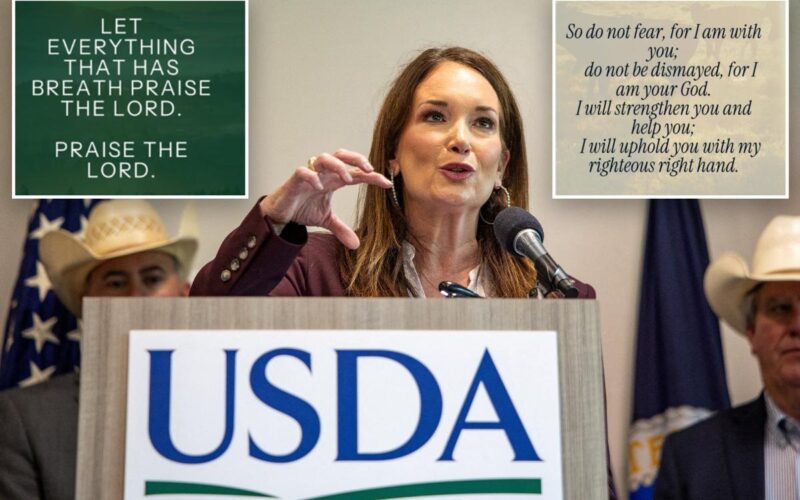
A federal judge ordered Agriculture Secretary Brooke Rollins Thursday to stop sending Christian exhortations and Scripture verses to her department’s roughly 100,000 employees, ruling that the missives violated the First Amendment.
Rollins, a Texas native and devout Christian, has repeatedly used USDA communications to promote her religious beliefs, including in messages marking Christmas, Easter and Thanksgiving.
In an April 5 Easter email to agency employees — first reported by POLITICO — Rollins celebrated the resurrection of Jesus Christ and compared USDA workers to “the very first disciples to encounter our risen Lord in the Upper Room almost two thousand years ago.”
She urged federal employees to embrace “Paschal joy” and remain confident in “the mission each of us has been called for.”
In a Dec. 23, 2025, email, Rollins included a video message in which she said “the spirit of generosity flows from the very first Christmas when God gave us the greatest gift possible, the gift of his Son and our Savior Jesus Christ, who came to free us from our sins and open the door to eternal life.”
San Francisco US District Judge Trina Thompson said Rollins’ use of government communications, combined with her position, amounted to pressuring employees to adopt her religious beliefs or conceal their own.
The judge took special issue with Rollins’ use of “we,” “us,” and “our” in her messages, which she said suggested Christianity was a shared belief among USDA employees.
The secretary did not send comparable messages recognizing other religious holidays.
“This Court’s judgment says nothing about the value of prayer or those who believe in its power,” Thompson wrote in a 21-page ruling. “Precisely because the tradition of worship and prayer is so personal and so cherished, protecting private devotion and spiritual reflection from government influence comes to the fore.”
Seven USDA workers and the National Federation of Federal Employees union sued Rollins this past May, arguing the secretary was subjecting them to “government-sponsored religious coercion.”
The “group of multifaith and nonreligious USDA employees” also argued that they could not simply ignore the messages, since Rollins used the same official channels to deliver important announcements.
Thompson agreed, ruling that the emails “suggest acquiescence that amounts to coercive pressure; a pressure of conformity sufficient to raise an Establishment Clause violation.”
Thompson’s injunction does not prevent Rollins from discussing her faith in her personal capacity or sharing her beliefs with interested colleagues.
However, the judge cited the USDA’s own workplace religious-expression policy in saying the secretary must stop such conversations if asked, cannot make “persistent unwelcome advances” related to religion, and cannot use her position to pressure subordinates.
The USDA called the ruling an “unprecedented attempt to muzzle a Cabinet Secretary” and said it was considering an appeal.