
Jensen Huang’s ouster as chief executive of Nvidia leaves a vacuum in Washington, where he was one of the strongest bulwarks against the regulation of artificial intelligence.
A confidant of President Trump, Mr. Huang successfully fought to open sales channels of A.I. chips to China. He also argued against A.I. safety regulations, which he said could hold back American companies in a global race with rivals. And he pushed for acceptance of open source technology, in which the underlying computer code for A.I. models is made public.
He mostly got his way.
Now, Mr. Huang is gone and bipartisan outrage is rising over the national security threats posed by allegations of his affair with a Chinese spy. The Nvidia co-founder’s Washington agenda — and White House officials who supported him — are under attack.
Voters last week swept Democrats, who have promised heavier A.I. regulation, into office. And a growing chorus of industry voices are cautioning that the technology has grown too dangerous, and that the government must step in to protect the public from rogue A.I. agents and economic disruption.
Mr. Huang has been “singularly” influential over American A.I. policy, said Samuel Hammond, the director of super intelligence policy at the Foundation for American Innovation, a right-leaning think tank focused on tech issues.
“His No. 1 prerogative has been gaining market access to China, by hook or by crook,” said Mr. Hammond, a critic of Nvidia’s efforts to limit export controls.
Mr. Huang’s prominence as Mr. Trump’s A.I. whisperer grew over the past two years as the technology exploded in popularity and Nvidia became the most valuable company in the world. Tech giants have helped propel the U.S. economy, lifting markets and plowing tens of billions of dollars into building A.I. infrastructure.
Mr. Huang and other tech chief executives also became close to the administration. They attended Mr. Trump’s inauguration and pledged multibillion-dollar manufacturing projects to promote the president’s economic agenda.
Some — including Elon Musk, the chief of SpaceX and Tesla, and Mark Zuckerberg, the chief of Meta — became powerful voices to sway the administration. Mr. Musk and Mr. Zuckerberg have often sided with Mr. Huang to tamp down A.I. safety rules and engage more with Chinese A.I. companies, according to three people familiar with their interactions.
Now more pro-regulatory voices are likely to fill the gap left by Mr. Huang. The A.I. start-up Anthropic has been a critic of chip exports to China. Dario Amodei, chief executive of Anthropic, Sam Altman, chief executive of OpenAI, and Demis Hassabis, head of Google DeepMind, have called for a nongovernmental independent agency to set standards and to test for safety.
Within the White House, Treasury Secretary Scott Bessent and others have pushed for greater enforcement of A.I. chip export rules. And Senators Elizabeth Warren, Democrat of Massachusetts, and Jim Banks, Republican of Indiana, in recent weeks have called for halting chip sales to China through restrictions in the National Defense Authorization Act, the annual budget approved by Congress for the Defense Department.
Any pullback on exports would come on top of potential lawmaker investigations into dealings between Nvidia and top Trump administration officials, including Commerce Secretary Howard Lutnick, for easing A.I. chip export restrictions to China. In May, Mr. Lutnick received a classified intelligence memo warning of Mr. Jensen’s affair with Alice Huang, an executive at the Singaporean data center company Megaspeed who is suspected of being a Chinese spy. Without Mr. Huang and with few allies, Nvidia is vulnerable, analysts said.
“Jensen and Nvidia were very dependent on the president’s support for their approach, and they don’t have a lot of other friends left because of the kind of scorched earth taken on so many of these issues,” said Chris McGuire, a senior fellow for China and emerging technologies at the Council on Foreign Relations and former senior State Department adviser. “That is a risky spot to be in.”
Nvidia and SpaceX did not immediately respond to requests for comment. Google and Anthropic declined to comment. The White Housedid not immediately offer a comment.
Mr. Huang, who founded Nvidia in 1993, for years was a reluctant figure in Washington politics. That changed after the Biden administration in 2022 introduced rules to block exports of A.I. chips to China and limit sales of chips to other nations, a direct shot at Nvidia, the dominant company in the field.
In Washington, intelligence officials and experts across the political spectrum increasingly sounded alarms over China’s potential to outrun the United States on A.I. development, which they feared would lead to an authoritarian use of A.I. by the Chinese government. Months into the new Trump administration in 2025, government officials began to contemplate expanding the Biden A.I. chip export ban.
Mr. Huang swung into action. He courted officials, including David Sacks, a venture capitalist and Mr. Trump’s top A.I. adviser, warning that any restrictions on American chipmakers would only strengthen Chinese chip companies like Huawei.
In April 2025, the Trump administration imposed the new chip export restrictions. In July 2025, Mr. Huang met with Mr. Trump at the Oval Office and urged him to reverse course. Despite warnings by national security officials, the administration rolled back the export controls.
“Jensen has been one of the loudest voices advocating for the sale of advanced A.I. chips to China,” said Ben Buchanan, a former Biden White House special adviser for A.I.. “This hands-off approach is exactly what China wants.”
Nvidia’s presence in Washington grew rapidly alongside Mr. Huang’s sway. The company spent $4.97 million on federal lobbying in 2025, up from $640,000 the year before, according to the nonpartisan group OpenSecrets. It has spent $4.69 million on lobbying in the first three quarters of this year.
Mr. Huang’s influence was on display again this year when the United States rushed to respond to the surging capabilities of open-source Chinese A.I. models, which make their source code or underlying calculations available to the public.
Some A.I. companies expressed concerns that Chinese developers were illicitly building their products by lifting from American models. But Mr. Huang defended open source models in private conversations with administration officials and lawmakers including Senators Jon Husted, Republican of Ohio, and Mark Warner, Democrat of Virginia.
In August, the White House unveiled a new framework to evaluate whether advanced A.I. models pose a risk to national security — and did not include open models.
At the same time, the A.I. industry was working with White House officials on a self-regulatory safety framework, according to three people with knowledge of the plans.
OpenAI, Anthropic and Google backed the idea of a standards and testing agency modeled on the Financial Industry Regulatory Authority, a nongovernmental body that enforces standards for financial institutions. The companies were in discussions with White House officials, who were working to bring a draft of the framework to the president for approval, the people said.
Mr. Huang and Mr. Zuckerberg were critics of the plan and lobbied for promises by the companies that they would test their models for safety, the people said. In late September, days before A.I. chiefs had been called to the White House for an announcement, the idea of a testing body was scrapped. Instead, the president announced that the companies had promised they would create safer systems, with no oversight agency.
(The New York Times sued OpenAI and Microsoft in 2023, claiming copyright infringement of news content related to A.I. systems. The two companies have denied those claims.)
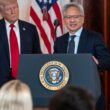
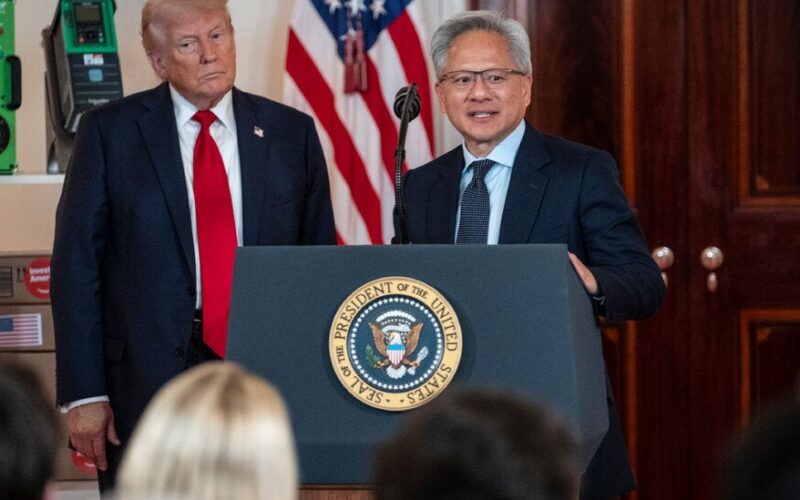
In October, Mr. Trump honored Mr. Huang with a national medal for science. The president praised Mr. Huang as “years and years ahead of other people and other companies” and Nvidia chips as the “backbone” of A.I. development. Afterward, Mr. Huang lingered onstage with the president, chatting and smiling.