



When Republicans started redrawing congressional maps in the summer of 2025, they hoped to gain enough seats to give the party a chance to hold the House in this year’s midterm elections.
That gambit did not come close to working. The Democrats won so overwhelmingly that they easily overcame the G.O.P.’s newly drawn lines. In many cases, Democrats wound up winning the seats that the Republicans targeted. Sometimes, Democrats even gained seats in the very states where Republicans redrew the maps to their advantage.
But do Democratic gains mean the Republican effort backfired? Did Republicans lose more seats in 2026 than they would have had they left the maps alone?
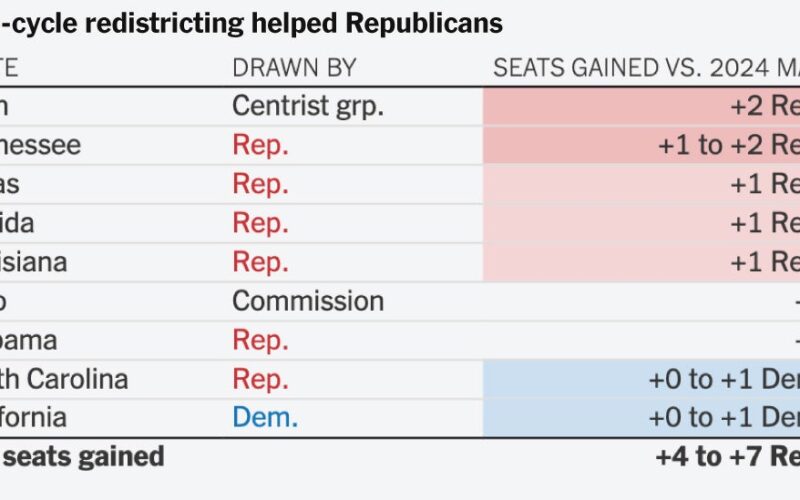
Our preliminary estimate is no, the Republican effort didn’t backfire. In fact, Republicans still gained anywhere from four to seven seats as a result of the new maps, even if they didn’t pay off as Republicans hoped.
There is one state where the Republican effort seems to have backfired, if only barely: North Carolina. Elsewhere, Republicans came out ahead or the new maps didn’t make a difference either way.
And even beyond the new maps enacted for 2026, Republicans still benefited enormously from partisan gerrymandering — not only in the states where they redrew maps in recent years, but elsewhere in the country as well. They may have even gained more seats in this election thanks to gerrymandering than they have in prior elections.
If every congressional map had been drawn fairly, with party-blind nonpartisan methods, Democrats might have come close to winning a veto-proof two-thirds majority in the House, with the party winning nearly 20 additional districts in Texas, Florida and Georgia alone.
It’s important to caution that these findings are still preliminary. Votes are still being counted in many states; in others, the detailed results by precinct aren’t yet available. Many districts are so close that even slight differences between our estimates and the actual outcome could be enough to flip the projected winner on the old map.
Nonetheless, it’s not too early to suggest that mid-cycle redistricting helped the G.O.P.
Texas is a good example. Republicans targeted five of the state’s 13 Democratic-held seats when they redrew the map last August, but Democrats came out of the midterms gaining a seat. While that might suggest that the Republican gerrymander backfired, Democrats would have won all of those same districts — including the one they gained — on the old map, even if the Republicans hadn’t redrawn the lines. Indeed, none of those districts were even close.
In reality, Republicans came out ahead with the new map in Texas. Democrats did gain a seat to win a total of 14 on the current map, but they would have won 15 if Republicans hadn’t redrawn it.
That’s because there’s a district — the 32nd, around Dallas — that Democrats would have won on the old map, but that Republicans successfully flipped this time. They redrew it to include much more Republican-leaning rural areas.
If anything, the Republican gerrymander in Texas played an enormous role in the results. Democrats won the U.S. House vote in Texas by about six percentage points, 53 percent to 47 percent, but Republicans still won a lopsided 24-to-14 congressional majority. On a hypothetical party-blind map, like one drawn by computer simulations, Democrats almost certainly would have won a majority of Texas’ House seats — with the simulations yielding an average of nine more Democratic seats in Texas.
Besides Texas, Republicans also did better on the new maps in Florida — and are projected to do better in Louisiana — than they might have on the old ones.
Did the Republican gerrymander backfire anywhere? North Carolina is the one state where Republicans may have been better off leaving the 2024 map alone — although so many districts are so close, on either the old or the new map, that a definitive answer will depend on the final vote count and the results by precinct.
But more often, the new maps didn’t make much of a difference. Democrats managed to hold the seats that Republicans sought to win in states like Ohio, and Alabama.
Even the Democratic gerrymander in California may not ultimately move a seat. Democrats redrew that map to try to cancel out the Republican effort in Texas. But as it turns out, Democrats appear to have been able to flip all the seats that they sought to flip even on the old map.
And oddly enough, Democrats may have been hurt in a state where a Republican gerrymander was dismantled ahead of the election: Utah. On the G.O.P.-drawn map — which was intended to be unanimously Republican — Democrats might have won two districts (though we’d need the exact precinct results to be sure). Instead, Democratic votes were concentrated in a single Salt Lake City district, guaranteeing them one seat, but only one.
Utah isn’t the only state where a seemingly favorable map for Democrats might have hurt the party in this year’s election. Based on computer simulations, Democrats probably fared worse in Arizona and New York than they would have on a party-blind map. In both cases (as with Utah), the current map solidifies Democratic-leaning seats but, in doing so, nudges a larger number of Republican-leaning districts out of play. In this year’s wave, Democrats would have been better off with more Republican-leaning seats in play.
Of course, all of this could work out differently in 2028. In a more competitive year, Republicans might be favored to win back the seats they failed to pick up this cycle. Similarly, Democrats wouldn’t be favored to win those light-red districts in New York, Utah and Arizona.
But even if the new maps fail to yield the decisive gains that Republicans had hoped, gerrymandering would still give the Republicans a meaningful structural advantage. And this cycle, that structural advantage made a major difference.
In a hypothetical world without gerrymandering, Democrats would have won many more seats in the big red states with successful Republican gerrymanders — Texas, Florida, Georgia and Tennessee — along with a longer list of districts where Republicans shored up seats that could plausibly be competitive, like those around Oklahoma City, Columbia, S.C., and Little Rock, Ark.
That would add up to 20-plus more seats, and Democrats would have been awfully close to winning the 290 seats necessary for a veto-proof majority. The last time any party held that many seats was in the 1970s, when Democrats won large gains in the House in the post-Watergate era.